The Future of Multidisciplinary Healthcare Research in the Era of Precision Medicine and Artificial Intelligence
DOI:
https://doi.org/10.68041/jmmhr.v1i1/01Keywords:
Precision Medicine, Artificial Intelligence, Multiomics, Biomedical Research, Machine Learning, Translational ResearchAbstract
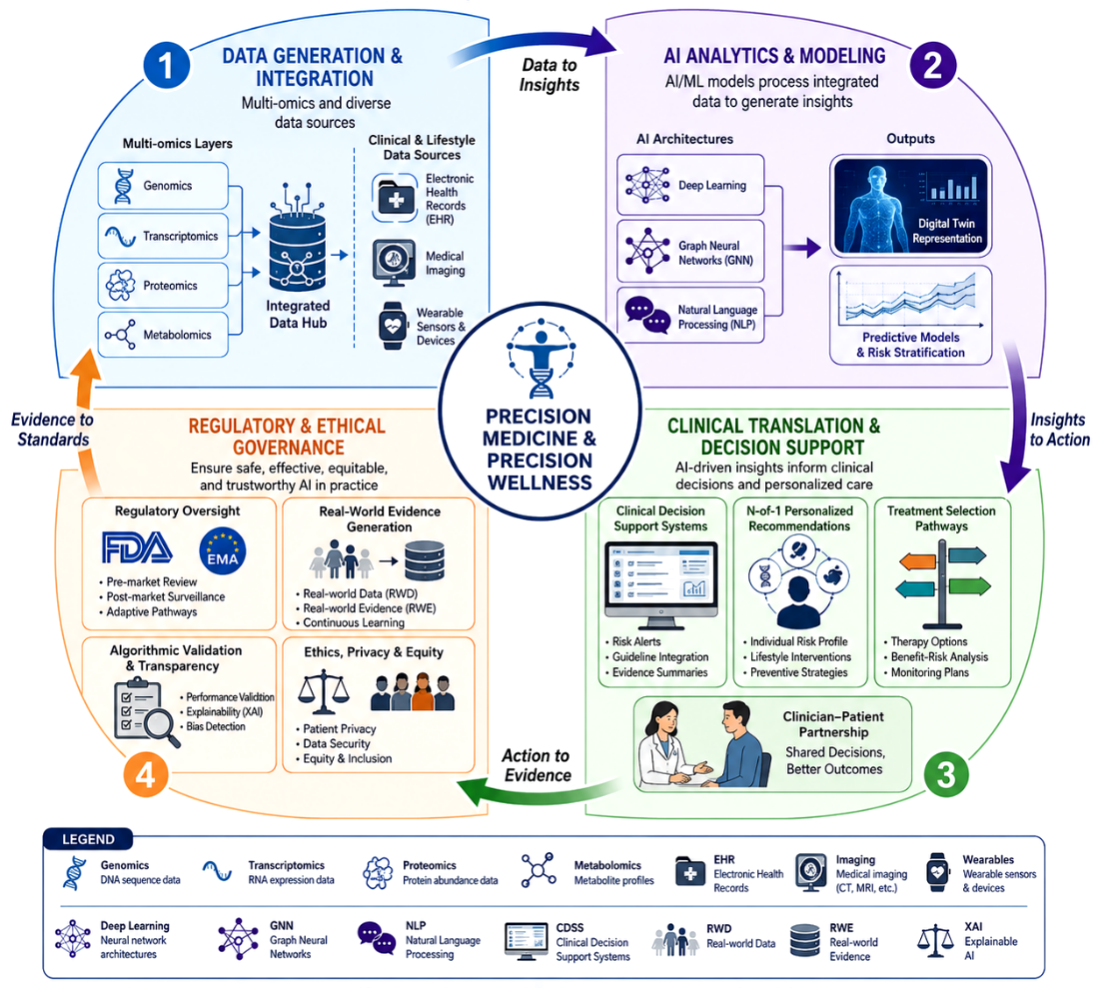
Precision medicine together with Artificial Intelligence (AI) technologies is paving the way for the transformation from population-based to person-centric approaches to health care, thereby dramatically altering the landscape of multidisciplinary research in medicine. This editorial delves into the transformative potential of multi-omics integration through AI, network medicine, and the emergence of next-generation precision wellness frameworks, highlighting a novel approach. These developments hold the potential to shorten the drug discovery process, improve the precision of diagnostics, and improve outcomes for patients, but there are important issues around data harmonization, transparency of algorithms, regulatory review, and equitable access. This editorial explores a journey towards “next generation precision medicine”, highlighting the potential to digital twins, federated learning and N-of-1 clinical decision support. Inter-disciplinary teamwork, strong validation structures and governance processes that uphold patient safety are needed for the future. In conclusion, to make progress toward the vision of precision healthcare, we need to rethink research models, clinical practice and regulatory processes to realize the full potential of AI while mitigating its limitations and biases.
References
1. Molla G, Bitew M. Revolutionizing personalized medicine: synergy with multi-omics data generation, main hurdles, and future perspectives. Biomedicines. 2024;12(12):2750.
https://doi.org/10.3390/biomedicines12122750
2. Li Y, Ma L, Wu D, Chen G. Advances in bulk and single-cell multi-omics approaches for systems biology and precision medicine. Brief Bioinform. 2021;22(5):bbab024. https://doi.org/10.1093/bib/bbab024
3. Tong L, Shi W, Isgut M, Zhong Y, Lais P, Gloster L, et al. Integrating multi-omics data with EHR for precision medicine using advanced artificial intelligence. IEEE Rev Biomed Eng. 2023;17:80-97. https://doi.org/10.1109/RBME.2023.3324264
4. Ahmed Z. Practicing precision medicine with intelligently integrative clinical and multi-omics data analysis. Hum Genomics. 2020;14(1):35. https://doi.org/10.1186/s40246-020-00287-z
5. OpenAI. ChatGPT (GPT-4o) [Computer Software]. 2026 [cited 2026 June 6]. Available from: https://chatgpt.com
6. Zack M, Stupichev DN, Moore AJ, Slobodchikov ID, Sokolov DG, Trifonov IF, et al. Artificial intelligence and multi-omics in pharmacogenomics: a new era of precision medicine. Mayo Clin Proc Digit Health. 2025;3(3):100246. https://doi.org/10.1016/j.mcpdig.2025.100246
7. Ahmed Z. Precision medicine with multi-omics strategies, deep phenotyping, and predictive analysis. Prog Mol Biol Transl Sci. 2022;190(1):101-25. https://doi.org/10.1016/bs.pmbts.2022.02.002
8. Raufaste-Cazavieille V, Santiago R, Droit A. Multi-omics analysis: Paving the path toward achieving precision medicine in cancer treatment and immuno-oncology. Front Mol Biosci. 2022;9:962743. https://doi.org/10.3389/fmolb.2022.962743
9. Marques L, Costa B, Pereira M, Silva A, Santos J, Saldanha L, et al. Advancing precision medicine: a review of innovative in silico approaches for drug development, clinical pharmacology and personalized healthcare. Pharmaceutics. 2024;16(3):332. https://doi.org/10.3390/pharmaceutics16030332
10. Serrano DR, Luciano FC, Anaya BJ, Ongoren B, Kara A, Molina G, et al. Artificial intelligence (AI) applications in drug discovery and drug delivery: revolutionizing personalized medicine. Pharmaceutics. 2024;16(10):1328. https://doi.org/10.3390/pharmaceutics16101328
11. Lee J, Choi J, Shin H, Lee JS, Kim EJ. Spatial multi-omics in precision medicine: Integrating biological insights through multidisciplinary collaboration. Semin Cancer Biol. 2026;119(1):24-37. https://doi.org/10.1016/j.semcancer.2025.12.009
12. Ross E, Ross J, Beschler P, Guydan D, Jamison R. Designing a Digital Twin for the Management of Noncommunicable Diseases: Protocol for a Pilot Study and Methodology Validation. JMIR Res Protoc. 2026;15(1):e75934. https://doi.org/10.2196/75934
13. Wang P, Leong QY, Lau NY, Ng WY, Kwek SP, Tan L, et al. N-of-1 medicine. Singapore Med J. 2024;65(3):167-75. https://doi.org/10.4103/singaporemedj.SMJ-2023-243
14. Su C, Wang P, Foo N, Ho D. Optimizing metabolic health with digital twins. npj Aging. 2025;11(1):20. https://doi.org/10.1038/s41514-025-00211-6
15. Augustine EF, Yu TW, Finkel RS. N-of-1 studies in an era of precision medicine. JAMA. 2024;332(16):1386-7. https://doi.org/10.1001/jama.2024.14637
16. Derraz B, Breda G, Kaempf C, Baenke F, Cotte F, Reiche K, et al. New regulatory thinking is needed for AI-based personalised drug and cell therapies in precision oncology. NPJ Precis Oncol. 2024;8(1):23. https://doi.org/10.1038/s41698-024-00517-w
17. Ota M, Fujio K. Multi-omics approach to precision medicine for immune-mediated diseases. Inflamm Regen. 2021;41(1):23. https://doi.org/10.1186/s41232-021-00173-8
18. Huang K, Lidbury BA, Thomas N, Gooley PR, Armstrong CW. Machine learning and multi-omics in precision medicine for ME/CFS. J Transl Med. 2025;23(1):68. https://doi.org/10.1186/s12967-024-05915-z
19. Ali H. Artificial intelligence in multi-omics data integration: Advancing precision medicine, biomarker discovery and genomic-driven disease interventions. Int J Sci Res Arch. 2023;8(1):1012-30. https://doi.org/10.30574/ijsra.2023.8.1.0189
20. Mendes JJ. Advancing the Understanding of Oral Health Through Multidisciplinary and Translational Perspectives Insights from a Special Issue of the Journal of Clinical Medicine. J Clin Med. 2025;14(17):6050. https://doi.org/10.3390/jcm14176050
21. Hartl D, de Luca V, Kostikova A, Laramie J, Kennedy S, Ferrero E, et al. Translational precision medicine: an industry perspective. J Transl Med. 2021;19(1):245. https://doi.org/10.1186/s12967-021-02910-6
Published
Issue
Section
License
Copyright (c) 2026 Amna Batool

This work is licensed under a Creative Commons Attribution-NonCommercial 4.0 International License.
Journal of Medical and Multidisciplinary Healthcare Research (JMMHR) follows the Attribution Creative Commons-Non commercial (CC BY-NC 4.0) license which allows the users to copy and redistribute the material in any medium or format, remix, transform and build upon the material. The users must give credit to the source and indicate, provide a link to the license, and indicate if changes were made. However, the CC BY-NC 4.0 license restricts the use of material for commercial purposes (Further details are available at website. The Editorial Board of the JSAMR endeavors to ensure the accuracy, integrity, and quality of all published content. However, the responsibility of opinions, interpretations, and conclusions expressed in the published articles rests entirely with the authors and do not necessarily reflect the views of the Editorial Board, publisher, or affiliated institutions.