
Blood-Brain Barrier Dysfunction after Traumatic Brain Injury: Molecular Pathways and Clinical Evidence -A Systematic Review
DOI:
https://doi.org/10.68041/jmmhr.v1i2/06Keywords:
Blood-Brain Barrier, Brain Injuries, Traumatic, Cerebrospinal Fluid, Magnetic Resonance Imaging, NeuroinflammationAbstract
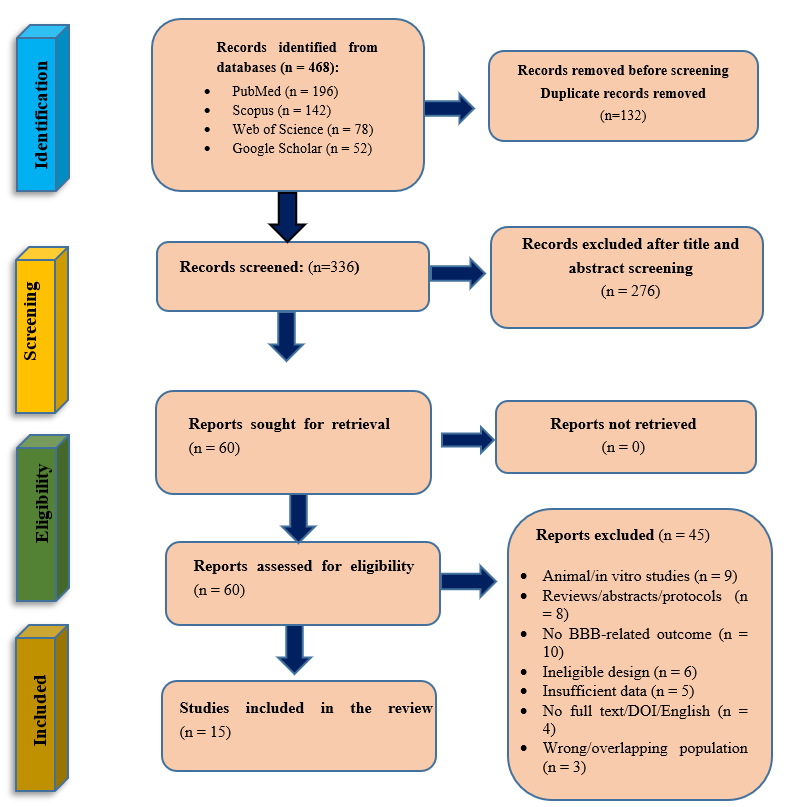
Objective: The blood–brain barrier (BBB) is an important component of the secondary injury mechanism in traumatic brain injury (TBI), associated with changes in BBB permeability, neuroinflammation, impaired protein clearance, and neurological deterioration. This systematic review aimed to synthesize clinical evidence on BBB dysfunction and associated molecular pathways following TBI. Data Sources: This review was conducted following PRISMA 2020 guidelines. PubMed, Scopus, Web of Science, and Google Scholar were searched from January 2019 to February 2026. Study Selection: Studies having BBB disruption or molecular mechanisms associated with BBB in human TBI using imaging, serum or plasma, CSF, or cerebral microdialysis methods were selected. Data Extraction: Two reviewers independently extracted data. QUADAS-2, adapted PROBAST, QUIPS, and adapted JBI tools were used to assess risk of bias. The GRADE approach was used to assess certainty of evidence. Data Synthesis: Fifteen studies met the inclusion criteria. Studies demonstrated the presence of BBB or blood–CSF barrier disruption by DCE-MRI, gadolinium leakage, permeability mapping, and meningeal enhancement. Biomarker studies found links between TBI and neurofilament light chain, GFAP, UCH-L1, S100B, NSE, inflammatory cytokines and chemokines, MMPs, and microdialysis proteins. These markers were correlated with injury severity, CT abnormalities, post-concussion symptoms, axonal injury, cerebral blood flow changes, and functional outcomes. The risk of bias was mostly moderate. Certainty of evidence was low to moderate. Conclusion: BBB dysfunction following TBI is associated with altered permeability, neuroaxonal damage, inflammation, proteinase activity, and impaired protein clearance. Larger standardized studies are needed to validate BBB biomarkers and clarify underlying molecular pathways.
References
1. Karaboue MAA, Ministeri F, Sessa F, Nannola C, Chisari MG, Cocimano G, et al. Traumatic Brain Injury as a Public Health Issue: Epidemiology, Prognostic Factors and Useful Data from Forensic Practice. Healthcare (Basel). 2024;12(22):2266. https://doi.org/10.3390/healthcare12222266 DOI: https://doi.org/10.3390/healthcare12222266
2. Simon DW, McGeachy MJ, Bayır H, Clark RSB, Loane DJ, Kochanek PM. Neuroinflammation in the evolution of secondary injury, repair, and chronic neurodegeneration after traumatic brain injury. Nat Rev Neurol. 2017;13(3):171–191. https://doi.org/10.1038/nrneurol.2017.13 DOI: https://doi.org/10.1038/nrneurol.2017.13
3. Kim S, Jung UJ, Kim SR. The crucial role of the blood–brain barrier in neurodegenerative diseases: mechanisms of disruption and therapeutic implications. J Clin Med. 2025;14(2):386. https://doi.org/10.3390/jcm14020386 DOI: https://doi.org/10.3390/jcm14020386
4. Sivandzade F, Alqahtani F, Cucullo L. Traumatic brain injury and blood–brain barrier (BBB): underlying pathophysiological mechanisms and the influence of cigarette smoking as a premorbid condition. Int J Mol Sci. 2020;21(8):2721. https://doi.org/10.3390/ijms21082721 DOI: https://doi.org/10.3390/ijms21082721
5. Cash A, Theus MH. Mechanisms of blood–brain barrier dysfunction in traumatic brain injury. Int J Mol Sci. 2020;21(9):3344. https://doi.org/10.3390/ijms21093344 DOI: https://doi.org/10.3390/ijms21093344
6. Yoo RE, Choi SH, Oh BM, Shin SD, Lee EJ, Shin DJ, et al. Quantitative dynamic contrast-enhanced MR imaging shows widespread blood-brain barrier disruption in mild traumatic brain injury patients with post-concussion syndrome. Eur Radiol. 2019;29(3):1308–1317. https://doi.org/10.1007/s00330-018-5656-z DOI: https://doi.org/10.1007/s00330-018-5656-z
7. Ware JB, Sinha S, Morrison J, Walter AE, Gugger JJ, Schneider ALC, et al. Dynamic contrast enhanced MRI for characterization of blood-brain-barrier dysfunction after traumatic brain injury. Neuroimage Clin. 2022;36:103236. https://doi.org/10.1016/j.nicl.2022.103236 DOI: https://doi.org/10.1016/j.nicl.2022.103236
8. van der Panne SA, Durrant H, Heuer JF, Kancheva I, Stellingwerf A, Verkaar LTKM, et al. Measuring blood–brain barrier dysfunction: a critical appraisal of fluid biomarkers, in vitro models, in vivo imaging, and post-mortem approaches. Alzheimers Dement. 2026;22(3):e71263. https://doi.org/10.1002/alz.71263 DOI: https://doi.org/10.1002/alz.71263
9. Hier DB, Obafemi-Ajayi T, Thimgan MS, Olbricht GR, Azizi S, Allen B, et al. Blood biomarkers for mild traumatic brain injury: a selective review of unresolved issues. Biomark Res. 2021;9(1):70. https://doi.org/10.1186/s40364-021-00325-5 DOI: https://doi.org/10.1186/s40364-021-00325-5
10. Page MJ, McKenzie JE, Bossuyt PM, Boutron I, Hoffmann TC, Mulrow CD, et al. The PRISMA 2020 statement: an updated guideline for reporting systematic reviews. Syst Rev. 2021;10(1):89. https://doi.org/10.1186/s13643-021-01626-4 DOI: https://doi.org/10.1186/s13643-021-01626-4
11. Whiting PF, Rutjes AWS, Westwood ME, Mallett S, Deeks JJ, Reitsma JB, et al. QUADAS-2: a revised tool for the quality assessment of diagnostic accuracy studies. Ann Intern Med. 2011;155(8):529–536. https://doi.org/10.7326/0003-4819-155-8-201110180-00009 DOI: https://doi.org/10.7326/0003-4819-155-8-201110180-00009
12. Wolff RF, Moons KGM, Riley RD, Whiting PF, Westwood M, Collins GS, et al. PROBAST: a tool to assess the risk of bias and applicability of prediction model studies. Ann Intern Med. 2019;170(1):51–58. https://doi.org/10.7326/M18-1376 DOI: https://doi.org/10.7326/M18-1376
13. Hayden JA, van der Windt DA, Cartwright JL, Côté P, Bombardier C. Assessing bias in studies of prognostic factors. Ann Intern Med. 2013;158(4):280–286. https://doi.org/10.7326/0003-4819-158-4-201302190-00009 DOI: https://doi.org/10.7326/0003-4819-158-4-201302190-00009
14. Munn Z, Barker TH, Moola S, Tufanaru C, Stern C, McArthur A, et al. Methodological quality of case series studies: an introduction to the JBI critical appraisal tool. JBI Evid Synth. 2020;18(10):2127–2133. https://doi.org/10.11124/JBISRIR-D-19-00099 DOI: https://doi.org/10.11124/JBISRIR-D-19-00099
15. Brignardello-Petersen R, Guyatt GH. Assessing the certainty of the evidence in systematic reviews: importance, process, and use. Am J Epidemiol. 2025;194(6):1681–1686. https://doi.org/10.1093/aje/kwae332 DOI: https://doi.org/10.1093/aje/kwae332
16. O’Keeffe E, Kelly E, Liu Y, Giordano C, Wallace E, Hynes M, et al. Dynamic Blood–Brain Barrier Regulation in Mild Traumatic Brain Injury. J Neurotrauma. 2020;37(2):347–356. https://doi.org/10.1089/neu.2019.6483 DOI: https://doi.org/10.1089/neu.2019.6483
17. Veksler R, Vazana U, Serlin Y, Prager O, Ofer J, Shemen N, et al. Slow blood-to-brain transport underlies enduring barrier dysfunction in American football players. Brain. 2020;143(6):1826–1842. https://doi.org/10.1093/brain/awaa140 DOI: https://doi.org/10.1093/brain/awaa140
18. Yoen H, Yoo RE, Choi SH, Kim E, Oh BM, Yang D, et al. Blood-Brain Barrier Disruption in Mild Traumatic Brain Injury Patients with Post-Concussion Syndrome: Evaluation with Region-Based Quantification of Dynamic Contrast-Enhanced MR Imaging Parameters Using Automatic Whole-Brain Segmentation. Korean J Radiol. 2021;22(1):118–130. https://doi.org/10.3348/kjr.2020.0016 DOI: https://doi.org/10.3348/kjr.2020.0016
19. Turtzo LC, Jikaria N, Cota MR, Williford JP, Uche V, Davis T, et al. Meningeal blood–brain barrier disruption in acute traumatic brain injury. Brain Commun. 2020;2(2):fcaa143. https://doi.org/10.1093/braincomms/fcaa143 DOI: https://doi.org/10.1093/braincomms/fcaa143
20. Davis TS, Nathan JE, Tinoco Martinez AS, De Vis JB, Turtzo LC, Latour LL. Comparison of T1-Post and FLAIR-Post MRI for identification of traumatic meningeal enhancement in traumatic brain injury patients. PLoS One. 2020;15(7):e0234881. https://doi.org/10.1371/journal.pone.0234881 DOI: https://doi.org/10.1371/journal.pone.0234881
21. Shahim P, Politis A, van der Merwe A, Moore B, Chou YY, Pham DL, et al. Neurofilament light as a biomarker in traumatic brain injury. Neurology. 2020;95(6):e610–e622. https://doi.org/10.1212/WNL.00000 DOI: https://doi.org/10.1212/WNL.0000000000009983
22. Lindblad C, Nelson DW, Zeiler FA, Ercole A, Ghatan PH, von Horn H, et al. Influence of Blood–Brain Barrier Integrity on Brain Protein Biomarker Clearance in Severe Traumatic Brain Injury: A Longitudinal Prospective Study. J Neurotrauma. 2020;37(12):1381–1391. https://doi.org/10.1089/neu.2019.6741 DOI: https://doi.org/10.1089/neu.2019.6741
23. Korley FK, Jain S, Sun X, Puccio AM, Yue JK, Gardner RC, et al. Prognostic value of day-of-injury plasma GFAP and UCH-L1 levels for predicting functional recovery in the TRACK-TBI cohort: an observational cohort study. Lancet Neurol. 2022;21(9):803–813. https://doi.org/10.1016/S1474-4422(22)00256-3 DOI: https://doi.org/10.1016/S1474-4422(22)00256-3
24. Tuure J, Mohammadian M, Tenovuo O, Blennow K, Hossain I, Hutchinson P, et al. Late Blood Levels of Neurofilament Light Correlate With Outcome in Patients With Traumatic Brain Injury. J Neurotrauma. 2024;41(3–4):359–368. https://doi.org/10.1089/neu.2023.0207 DOI: https://doi.org/10.1089/neu.2023.0207
25. Koivikko P, Posti JP, Mohammadian M, Lagerstedt L, Azurmendi L, Hossain I, et al. Potential of heart fatty-acid binding protein, neurofilament light, interleukin-10 and S100 calcium-binding protein B in the acute diagnostics and severity assessment of traumatic brain injury. Emerg Med J. 2022;39(3):206–212. https://doi.org/10.1136/emermed-2020-209471 DOI: https://doi.org/10.1136/emermed-2020-209471
26. Dyhrfort P, Shen Q, Clausen F, Thulin M, Enblad P, Kamali-Moghaddam M, et al. Monitoring of Protein Biomarkers of Inflammation in Human Traumatic Brain Injury Using Microdialysis and Proximity Extension Assay Technology in Neurointensive Care. J Neurotrauma. 2019;36(20):2872–2885. https://doi.org/10.1089/neu.2018.6320 DOI: https://doi.org/10.1089/neu.2018.6320
27. Yue JK, Kobeissy FH, Jain S, Sun X, Phelps RRL, Korley FK, et al. Neuroinflammatory Biomarkers for Traumatic Brain Injury Diagnosis and Prognosis: A TRACK-TBI Pilot Study. Neurotrauma Rep. 2023;4(1):171–183. https://doi.org/10.1089/neur.2022.0060 DOI: https://doi.org/10.1089/neur.2022.0060
28. Dyhrfort P, Wettervik TS, Clausen F, Enblad P, Hillered L, Lewén A. A Dedicated 21-Plex Proximity Extension Assay Panel for High-Sensitivity Protein Biomarker Detection Using Microdialysis in Severe Traumatic Brain Injury: The Next Step in Precision Medicine? Neurotrauma Rep. 2023;4(1):25–40. https://doi.org/10.1089/neur.2022.0067 DOI: https://doi.org/10.1089/neur.2022.0067
29. Churchill NW, Di Battista AP, Rhind SG, Richards D, Schweizer TA, Hutchison MG. Cerebral blood flow is associated with matrix metalloproteinase levels during the early symptomatic phase of concussion. PLoS One. 2021;16(11):e0253134. https://doi.org/10.1371/journal.pone.0253134 DOI: https://doi.org/10.1371/journal.pone.0253134
30. Huie JR, Diaz-Arrastia R, Yue JK, Sorani MD, Puccio AM, Okonkwo DO, et al. Testing a Multivariate Proteomic Panel for Traumatic Brain Injury Biomarker Discovery: A TRACK-TBI Pilot Study. J Neurotrauma. 2019;36(1):100–110. https://doi.org/10.1089/neu.2017.5449 DOI: https://doi.org/10.1089/neu.2017.5449
31. Chodobski A, Zink BJ, Szmydynger-Chodobska J. Blood-brain barrier pathophysiology in traumatic brain injury. Transl Stroke Res. 2011;2(4):492–516. https://doi.org/10.1007/s12975-011-0125-x DOI: https://doi.org/10.1007/s12975-011-0125-x
32. Maas AIR, Menon DK, Adelson PD, Andelic N, Bell MJ, Belli A, et al. Traumatic brain injury: progress and challenges in prevention, clinical care, and research. Lancet Neurol. 2022;21(11):1004–1060. https://doi.org/10.1016/S1474-4422(22)00309-X DOI: https://doi.org/10.1016/S1474-4422(22)00309-X
33. tocchetti N, Carbonara M, Citerio G, Ercole A, Skrifvars MB, Smielewski P, et al. Severe traumatic brain injury: targeted management in the intensive care unit. Lancet Neurol. 2017;16(6):452–464. https://doi.org/10.1016/S1474-4422(17)30118-7 DOI: https://doi.org/10.1016/S1474-4422(17)30118-7
34. Hill CS, Coleman MP, Menon DK. Traumatic axonal injury: mechanisms and translational opportunities. Trends Neurosci. 2016;39(5):311–324. https://doi.org/10.1016/j.tins.2016.03.002 DOI: https://doi.org/10.1016/j.tins.2016.03.002
35. Joseph CR, Casey AT, Shenton ME, Bouix S. Assessing mild traumatic brain injury-associated blood–brain barrier dysfunction using MRI. Int J Mol Sci. 2024;25(21):11522. https://doi.org/10.3390/ijms252111522 DOI: https://doi.org/10.3390/ijms252111522
36. Oh SS, Lee EH, Kim JH, Seo YB, Choo YJ, Park J, et al. The use of dynamic contrast-enhanced magnetic resonance imaging for the evaluation of blood-brain barrier disruption in traumatic brain injury: what is the evidence? Brain Sci. 2021;11(6):775. https://doi.org/10.3390/brainsci11060775 DOI: https://doi.org/10.3390/brainsci11060775
37. Bischof GN, Cross DJ. Brain trauma imaging. J Nucl Med. 2023;64(1):20–29. https://doi.org/10.2967/jnumed.121.263293 DOI: https://doi.org/10.2967/jnumed.121.263293
38. Helmy A, Guilfoyle MR, Carpenter KLH, Pickard JD, Menon DK, Hutchinson PJA. Recombinant human interleukin-1 receptor antagonist promotes M1 microglia biased cytokines and chemokines following human traumatic brain injury. J Cereb Blood Flow Metab. 2016;36(8):1434–1448. https://doi.org/10.1177/0271678X15620204 DOI: https://doi.org/10.1177/0271678X15620204
39. Papa L, Brophy GM, Welch RD, Lewis LM, Braga CF, Tan CN, et al. Time course and diagnostic accuracy of glial and neuronal blood biomarkers GFAP and UCH-L1 in a large cohort of trauma patients with and without mild traumatic brain injury. JAMA Neurol. 2016;73(5):551–560. https://doi.org/10.1001/jamaneurol.2016.0039 DOI: https://doi.org/10.1001/jamaneurol.2016.0039
40. Thelin EP, Jeppsson E, Frostell A, Svensson M, Mondello S, Bellander BM, et al. Utility of neuron-specific enolase in traumatic brain injury: relations to S100B levels, outcome, and extracranial injury severity. Crit Care. 2016;20(1):285. https://doi.org/10.1186/s13054-016-1450-y DOI: https://doi.org/10.1186/s13054-016-1450-y
41. Zetterberg H, Smith DH, Blennow K. Biomarkers of mild traumatic brain injury in cerebrospinal fluid and blood. Nat Rev Neurol. 2013;9(4):201–210. https://doi.org/10.1038/nrneurol.2013.9 DOI: https://doi.org/10.1038/nrneurol.2013.9
42. Plog BA, Dashnaw ML, Hitomi E, Peng W, Liao Y, Lou N, et al. Biomarkers of traumatic injury are transported from brain to blood via the glymphatic system. J Neurosci. 2015;35(2):518–526. https://doi.org/10.1523/JNEUROSCI.3742-14.2015 DOI: https://doi.org/10.1523/JNEUROSCI.3742-14.2015
43. Abdul-Muneer PM, Pfister BJ, Haorah J, Chandra N. Role of matrix metalloproteinases in the pathogenesis of traumatic brain injury. Mol Neurobiol. 2016;53(9):6106–6123. https://doi.org/10.1007/s12035-015-9520-8 DOI: https://doi.org/10.1007/s12035-015-9520-8
44. Guilfoyle MR, Carpenter KLH, Helmy A, Pickard JD, Menon DK, Hutchinson PJA. Matrix metalloproteinase expression in contusional traumatic brain injury: a paired microdialysis study. J Neurotrauma. 2015;32(20):1553–1559. https://doi.org/10.1089/neu.2014.3764 DOI: https://doi.org/10.1089/neu.2014.3764
45. Wu M, Sun J, Wang Y, Zhang Y, Hu L, Gong X, et al. VEGF regulates the blood-brainbarrier through MMP-9 in a rat traumatic brain injury model. Mol Med Rep. 2022;26(5):348. https://doi.org/10.3892/mmr.2022.12832 DOI: https://doi.org/10.3892/etm.2022.11664
46. Lassarén P, Lindblad C, Frostell A, Thelin EP, Kamali-Moghaddam M, Svensson M, et al. Systemic inflammation alters the neuroinflammatory response: a prospective clinical trial in traumatic brain injury. J Neuroinflammation. 2021;18(1):221. https://doi.org/10.1186/s12974-021-02264-2 DOI: https://doi.org/10.1186/s12974-021-02264-2
Downloads
Published
Issue
Section
License
Copyright (c) 2026 Mohsin Ali, Hamayun Saqib

This work is licensed under a Creative Commons Attribution-NonCommercial 4.0 International License.
Journal of Medical and Multidisciplinary Healthcare Research (JMMHR) follows the Attribution Creative Commons-Non commercial (CC BY-NC 4.0) license which allows the users to copy and redistribute the material in any medium or format, remix, transform and build upon the material. The users must give credit to the source and indicate, provide a link to the license, and indicate if changes were made. However, the CC BY-NC 4.0 license restricts the use of material for commercial purposes (Further details are available at website. The Editorial Board of the JSAMR endeavors to ensure the accuracy, integrity, and quality of all published content. However, the responsibility of opinions, interpretations, and conclusions expressed in the published articles rests entirely with the authors and do not necessarily reflect the views of the Editorial Board, publisher, or affiliated institutions.