Advancing Multidisciplinary Health Research: Bridging Clinical Practice, Public Health, and Translational Science
DOI:
https://doi.org/10.68041/jmmhr.v1i2/01Keywords:
Delivery of Health Care, Evidence-Based Medicine, Interdisciplinary Research, Public Health, Translational Research, BiomedicalAbstract
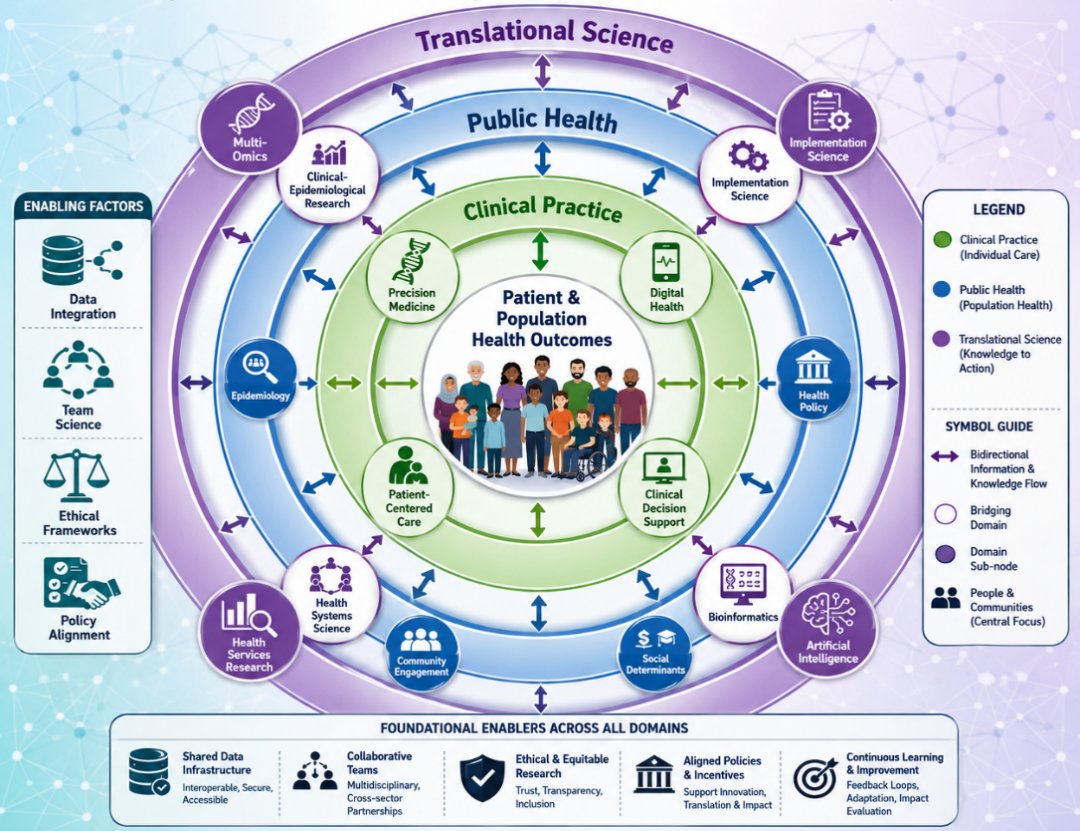
Precision Modern health care is characterized by complex challenges that stretch beyond scientific disciplines. It requires solutions and methods that integrate clinical practice, public health and translational science approaches. The need for multidisciplinary health research is explored in this editorial, and strategies are discussed on how to bridge the gap in translational research between individualized patient care and population health, and between discovery and implementation. It examines the existing challenges such as institutional silos, a lack of data integration, and misaligned incentives, but also identifies opportunities for change and transformation offered by AI, multi-omics integration, and innovative collaborative approaches. In the future, health research will be truly transdisciplinary rather than just interdisciplinary, considering health as an emerging characteristic of the harmonious interaction of biological, behavioral, social, and environmental systems.
References
1. Smye SW, Frangi AF. Interdisciplinary research: shaping the healthcare of the future. Future Healthc J. 2021;8(2):e218-23. https://doi.org/10.7861/fhj.2021-0025 DOI: https://doi.org/10.7861/fhj.2021-0025
2. Bertagnolli MM. Advancing health through artificial intelligence/machine learning: the critical importance of multidisciplinary collaboration. PNAS Nexus. 2023;2(12):pgad356. https://doi.org/10.1093/pnasnexus/pgad356 DOI: https://doi.org/10.1093/pnasnexus/pgad356
3. Schramme T. Health as complete well-being: The WHO definition and beyond. Public Health Ethics. 2023;16(3):210-8. https://doi.org/10.1093/phe/phad017 DOI: https://doi.org/10.1093/phe/phad017
4. OpenAI. ChatGPT (GPT-4o) [Computer Software]. 2026 [cited 2026 July 6]. Available from: https://chatgpt.com
5. Udensi CG, Vunnava R, Durojaye TJ. Interdisciplinary collaboration in healthcare management: Strengthening healthcare delivery‒A review. Int J Adv Multidiscip Res Stud. 2025;5(5):210-6. https://doi.org/10.62225/2583049X.2025.5.5.4881 DOI: https://doi.org/10.62225/2583049X.2025.5.5.4881
6. Robinson PC, Liew DF, Tanner HL, Grainger JR, Dwek RA, Reisler RB, et al. COVID-19 therapeutics: Challenges and directions for the future. Proc Natl Acad Sci USA. 2022;119(15):e2119893119. https://doi.org/10.1073/pnas.2119893119 DOI: https://doi.org/10.1073/pnas.2119893119
7. Olver P, Bohn MK, Adeli K. Central role of laboratory medicine in public health and patient care. Clin Chem Lab Med. 2023;61(4):666-73. https://doi.org/10.1515/cclm-2022-1075 DOI: https://doi.org/10.1515/cclm-2022-1075
8. Iqbal J, Jaimes DC, Makineni P, Subramani S, Hemaida S, Thugu TR, et al. Reimagining healthcare: unleashing the power of artificial intelligence in medicine. Cureus. 2023;15(9):e44658. https://doi.org/10.7759/cureus.44658 DOI: https://doi.org/10.7759/cureus.44658
9. Yu X. Pioneering Multidisciplinary Innovation: A Year in Review and Vision for the Future. Med Adv. 2025;3(1):7-8. https://doi.org/10.1002/med4.90 DOI: https://doi.org/10.1002/med4.90
10. Tong L, Shi W, Isgut M, Zhong Y, Lais P, Gloster L, et al. Integrating multi-omics data with EHR for precision medicine using advanced artificial intelligence. IEEE Rev Biomed Eng. 2023;17:80-97. https://doi.org/10.1109/RBME.2023.3324264 DOI: https://doi.org/10.1109/RBME.2023.3324264
11. Carini C, Seyhan AA. Tribulations and future opportunities for artificial intelligence in precision medicine. J Transl Med. 2024;22(1):411. https://doi.org/10.1186/s12967-024-05067-0 DOI: https://doi.org/10.1186/s12967-024-05067-0
12. Sahu M, Gupta R, Ambasta RK, Kumar P. Artificial intelligence and machine learning in precision medicine: A paradigm shift in big data analysis. Prog Mol Biol Transl Sci. 2022;190(1):57-100. https://doi.org/10.1016/bs.pmbts.2022.03.002 DOI: https://doi.org/10.1016/bs.pmbts.2022.03.002
13. Brazel D, Kazakova V, Fay M, Bollin K, Mittal K, Reynolds KL, et al. Connecting the dots: practical strategies for academic and community oncology synergy to advance multidisciplinary management in immunotherapy toxicity care. Am Soc Clin Oncol Educ Book. 2025;45(3):e473080. https://doi.org/10.1200/EDBK-25-473080 DOI: https://doi.org/10.1200/EDBK-25-473080
14. Dawe J, Cronshaw H, Frerk C. Learning from the multidisciplinary team: advancing patient care through collaboration. Br J Hosp Med. 2024;85(5):1-4. https://doi.org/10.12968/hmed.2023.0387 DOI: https://doi.org/10.12968/hmed.2023.0387
15. Mendes JJ. Advancing the Understanding of Oral Health Through Multidisciplinary and Translational Perspectives Insights from a Special Issue of the Journal of Clinical Medicine. J Clin Med. 2025;14(17):6050. https://doi.org/10.3390/jcm14176050 DOI: https://doi.org/10.3390/jcm14176050
Downloads
Published
Issue
Section
License
Copyright (c) 2026 Raiyna Kramat, Mubashra Inam

This work is licensed under a Creative Commons Attribution-NonCommercial 4.0 International License.
Journal of Medical and Multidisciplinary Healthcare Research (JMMHR) follows the Attribution Creative Commons-Non commercial (CC BY-NC 4.0) license which allows the users to copy and redistribute the material in any medium or format, remix, transform and build upon the material. The users must give credit to the source and indicate, provide a link to the license, and indicate if changes were made. However, the CC BY-NC 4.0 license restricts the use of material for commercial purposes (Further details are available at website. The Editorial Board of the JSAMR endeavors to ensure the accuracy, integrity, and quality of all published content. However, the responsibility of opinions, interpretations, and conclusions expressed in the published articles rests entirely with the authors and do not necessarily reflect the views of the Editorial Board, publisher, or affiliated institutions.