
Clinical Presentation, Disease Characteristics, and Predictors of Advanced-Stage Disease Among Patients with Lung Cancer
DOI:
https://doi.org/10.68041/jmmhr.v1i2/04Keywords:
Dyspnea, Lung Neoplasms, Neoplasm Metastasis, Neoplasm Staging, SmokingAbstract
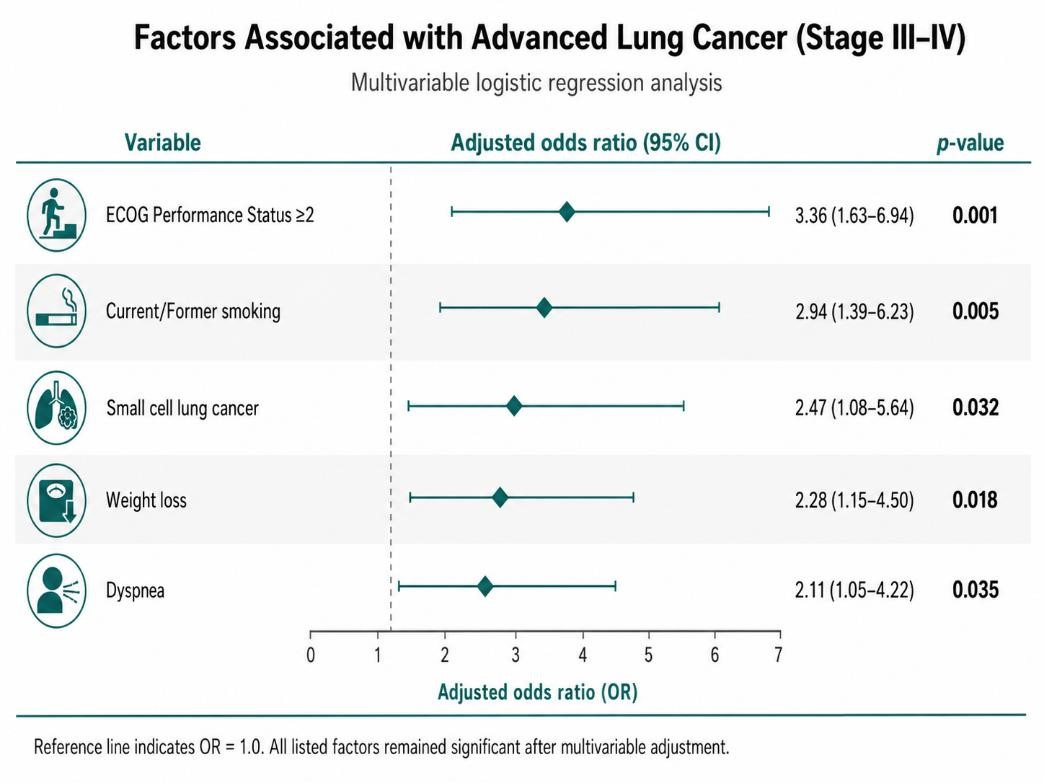
Background: Lung cancer is a leading cause of cancer-related morbidity and mortality and is often diagnosed at a late stage. This study aimed to characterize the clinical presentation, disease characteristics and identify independent predictors associated with advanced-stage lung cancer in primary lung cancer patients. Methods: This descriptive cross-sectional study was carried out for 6 months on 150 adult patients with primary lung. Information was gathered on demographic data, smoking habits, presenting symptoms, histology, tumor stage, metastatic status, and ECOG performance status via interviews, clinical examination, and medical record reviews. Stage III–IV disease was the outcome for multivariable logistic regression. Data were analyzed using SPSS version 26.0, descriptive statistics, association tests, and multivariable logistic regression; p<0.05 was considered significant. Results: The mean age was 61.8 ± 10.9 years, and 102 (68.0%) were male. The most common histological type was NSCLC 117 (78.0%). Persistent cough 111 (74.0%), weight loss 71 (60.7%), dyspnea 88 (58.7%), fatigue 83 (55.3%), and chest pain 79 (52.7%) were common. Overall, 97 (64.7%) had stage III-IV disease and 58(38.7%) had metastasis. Independent predictors were ECOG ≥2 (AOR=3.36; 95% CI: 1.63–6.94; p=0.001), current/former smoking (AOR=2.94; 95% CI: 1.39–6.23; p=0.005), SCLC (AOR=2.47; 95% CI: 1.08–5.64; p=0.032) weight loss (AOR=2.28; 95% CI: 1.15–4.50; p=0.018), and dyspnea (AOR=2.11; 95% CI: 1.05–4.22; p=0.035. Conclusion: Timely lung cancer diagnosis may be facilitated by early symptom recognition, risk-based referral, and comprehensive staging. These predictors require validation to assess their impact on early detection and treatment planning in future studies.References
1. Shong LYW, Lam DCL. Emerging trends in global lung cancer burden. Semin Respir Crit Care Med. 2025;46(5):409–418. https://doi.org/10.1055/a-2651-0612 DOI: https://doi.org/10.1055/a-2651-0612
2. Lancaster HL, Heuvelmans MA, Oudkerk M. Low-dose computed tomography lung cancer screening: clinical evidence and implementation research. J Intern Med. 2022;292(1):68–80. https://doi.org/10.1111/joim.13480 DOI: https://doi.org/10.1111/joim.13480
3. Jassem J. Tobacco smoking after diagnosis of cancer: clinical aspects. Transl Lung Cancer Res. 2019;8(Suppl 1)–S58. https://doi.org/10.21037/tlcr.2019.04.01 DOI: https://doi.org/10.21037/tlcr.2019.04.01
4. Rojiani MV, Rojiani AM. Non-small cell lung cancer—tumor biology. Cancers. 2024;16(4):716. https://doi.org/10.3390/cancers16040716 DOI: https://doi.org/10.3390/cancers16040716
5. Kim SY, Park HS, Chiang AC. Small cell lung cancer: a review. JAMA. 2025;333(21):1906–1917. https://doi.org/10.1001/jama.2025.0560 DOI: https://doi.org/10.1001/jama.2025.0560
6. Patel AM, Peters SG. Clinical manifestations of lung cancer. Mayo Clin Proc. 1993;68(3):273–277. https://doi.org/10.1016/S0025-6196(12)60049-4 DOI: https://doi.org/10.1016/S0025-6196(12)60049-4
7. Suchsland MZ, Kowalski L, Burkhardt HA, Prado MG, Kessler LG, Yetisgen M, et al. How timely is diagnosis of lung cancer? Cohort study of individuals with lung cancer presenting in ambulatory care in the United States. Cancers. 2022;14(23):5756. https://doi.org/10.3390/cancers14235756 DOI: https://doi.org/10.3390/cancers14235756
8. Saab MM, McCarthy M, O’Driscoll M, Sahm LJ, Leahy-Warren P, Noonan B, et al. A systematic review of interventions to recognise, refer and diagnose patients with lung cancer symptoms. npj Prim Care Respir Med. 2022;32(1):42. https://doi.org/10.1038/s41533-022-00312-9 DOI: https://doi.org/10.1038/s41533-022-00312-9
9. Balata H, Quaife SL, Craig C, Ryan DJ, Bradley P, Crosbie PAJ, et al. Early diagnosis and lung cancer screening. Clin Oncol (R Coll Radiol). 2022;34(11):708–715. https://doi.org/10.1016/j.clon.2022.08.036 DOI: https://doi.org/10.1016/j.clon.2022.08.036
10. National Lung Screening Trial Research Team. Results of initial low-dose computed tomographic screening for lung cancer. N Engl J Med. 2013;368(21):1980-91. https://doi.org/10.1056/NEJMoa1209120 DOI: https://doi.org/10.1056/NEJMoa1209120
11. Sullivan KM, Dean A, Soe MM. OpenEpi: a web-based epidemiologic and statistical calculator for public health. Public Health Rep. 2009;124(3):471–474. https://doi.org/10.1177/003335490912400320 DOI: https://doi.org/10.1177/003335490912400320
12. Goodyear MDE, Krleza-Jeric K, Lemmens T. The Declaration of Helsinki. BMJ. 2007;335(7621):624–625. https://doi.org/10.1136/bmj.39339.610000 DOI: https://doi.org/10.1136/bmj.39339.610000.BE
13. Costa GJ, Mello MJG, Bergmann A, Ferreira CG, Thuler LCS. Tumor-node-metastasis staging and treatment patterns of 73,167 patients with lung cancer in Brazil. J Bras Pneumol. 2020;46(1). https://doi.org/10.1590/1806-3713/e20180251 DOI: https://doi.org/10.1590/1806-3713/e20180251
14. Jadhav S, Handa A, Kumar S, Chowdhury GS. Study of clinical presentations of lung cancer in tertiary level hospital. Int J Adv Med. 2022;9(2):107–112. https://doi.org/10.18203/2349-3933.ijam20220117 DOI: https://doi.org/10.18203/2349-3933.ijam20220117
15. Xing PY, Zhu YX, Wang L, Hui ZG, Liu SM, Ren JS, et al. What are the clinical symptoms and physical signs for non-small cell lung cancer before diagnosis is made? A nationwide multicenter 10-year retrospective study in China. Cancer Med. 2019;8(8):4055–4069. https://doi.org/10.1002/cam4.2256 DOI: https://doi.org/10.1002/cam4.2256
16. Nath A, Sathishkumar K, Das P, Sudarshan KL, Mathur P. A clinicoepidemiological profile of lung cancers in India: results from the National Cancer Registry Programme. Indian J Med Res. 2022;155(2):264–272. https://doi.org/10.4103/ijmr.ijmr_1364_21 DOI: https://doi.org/10.4103/ijmr.ijmr_1364_21
17. Polanco D, Pinilla L, Gracia-Lavedan E, Mas A, Bertran S, Fierro G, et al. Prognostic value of symptoms at lung cancer diagnosis: a three-year observational study. J Thorac Dis. 2021;13(3):1485–1494. https://doi.org/10.21037/jtd-20-3075 DOI: https://doi.org/10.21037/jtd-20-3075
18. Harle ASM, Blackhall FH, Smith JA, Molassiotis A. Cough and its management in patients with lung cancer: a systematic review of literature. Lung Cancer. 2013;82(2):197–205. https://doi.org/10.1016/j.lungcan.2013.07.015 DOI: https://doi.org/10.1016/j.lungcan.2013.07.015
19. Prado MG, Kessler LG, Au MA, Burkhardt HA, Zigman Suchsland M, Kowalski L, et al. Symptoms and signs of lung cancer prior to diagnosis: case-control study using electronic health records from ambulatory care within a large US-based tertiary care centre. BMJ Open. 2023;13(4):e068832. https://doi.org/10.1136/bmjopen-2022-068832 DOI: https://doi.org/10.1136/bmjopen-2022-068832
20. Rogers I, Cooper M, Memon A, Forbes L, van Marwijk H, Ford E. The effect of comorbidities on diagnostic interval for lung cancer in England: a cohort study using electronic health record data. Br J Cancer. 2024;131(7):1147–1157. https://doi.org/10.1038/s41416-024-02824-2 DOI: https://doi.org/10.1038/s41416-024-02824-2
21. Zhu J, Branstetter S, Lazarus P, Muscat JE. Smoking, lung cancer stage, and prognostic factors—findings from the National Lung Screening Trial. Int J Environ Res Public Health. 2024;21(4):400. https://doi.org/10.3390/ijerph21040400 DOI: https://doi.org/10.3390/ijerph21040400
22. Walter FM, Rubin G, Bankhead C, Morris HC, Hall N, Mills K, et al. Symptoms and other factors associated with time to diagnosis and stage of lung cancer: a prospective cohort study. Br J Cancer. 2015;112(Suppl 1)–S13. https://doi.org/10.1038/bjc.2015.30 DOI: https://doi.org/10.1038/bjc.2015.30
23. Provencio M, Carcereny E, Rodríguez-Abreu D, López-Castro R, Guirado M, Camps C, et al. Lung cancer in Spain: information from the Thoracic Tumors Registry (TTR study). Transl Lung Cancer Res. 2019;8(4):461–475. https://doi.org/10.21037/tlcr.2019.08.0 DOI: https://doi.org/10.21037/tlcr.2019.08.05
24. van Os S, Syversen A, Whitaker KL, Quaife SL, Janes SM, Jallow M, et al. Lung cancer symptom appraisal, help-seeking and diagnosis: rapid systematic review of differences between patients with and without a smoking history. Psycho-Oncology. 2022;31(4):562–576. https://doi.org/10.1002/pon.5846 DOI: https://doi.org/10.1002/pon.5846
25. Lilenbaum RC, Cashy J, Hensing TA, Young S, Cella D. Prevalence of poor performance status in lung cancer patients: implications for research. J Thorac Oncol. 2008;3(2):125–129. https://doi.org/10.1097/JTO.0b013e3181622c17 DOI: https://doi.org/10.1097/JTO.0b013e3181622c17
26. Ruano-Raviña A, Provencio M, Calvo de Juan V, Carcereny E, Moran T, Rodriguez-Abreu D, et al. Lung cancer symptoms at diagnosis: results of a nationwide registry study. ESMO Open. 2020;5(6). https://doi.org/10.1136/esmoopen-2020-001021 DOI: https://doi.org/10.1136/esmoopen-2020-001021
27. Nakazawa K, Kurishima K, Tamura T, Kagohashi K, Ishikawa H, Satoh H, et al. Specific organ metastases and survival in small cell lung cancer. Oncol Lett. 2012;4(4):617–620. https://doi.org/10.3892/ol.2012.792 DOI: https://doi.org/10.3892/ol.2012.792
28. Dingemans AMC, Früh M, Ardizzoni A, Besse B, Faivre-Finn C, Hendriks LE, et al. Small-cell lung cancer: ESMO Clinical Practice Guidelines for diagnosis, treatment and follow-up. Ann Oncol. 2021;32(7):839–853. https://doi.org/10.1016/j.annonc.2021.03.207 DOI: https://doi.org/10.1016/j.annonc.2021.03.207
Downloads
Published
Issue
Section
License
Copyright (c) 2026 Zafar Junaid, Muhammad Khaliq

This work is licensed under a Creative Commons Attribution-NonCommercial 4.0 International License.
Journal of Medical and Multidisciplinary Healthcare Research (JMMHR) follows the Attribution Creative Commons-Non commercial (CC BY-NC 4.0) license which allows the users to copy and redistribute the material in any medium or format, remix, transform and build upon the material. The users must give credit to the source and indicate, provide a link to the license, and indicate if changes were made. However, the CC BY-NC 4.0 license restricts the use of material for commercial purposes (Further details are available at website. The Editorial Board of the JSAMR endeavors to ensure the accuracy, integrity, and quality of all published content. However, the responsibility of opinions, interpretations, and conclusions expressed in the published articles rests entirely with the authors and do not necessarily reflect the views of the Editorial Board, publisher, or affiliated institutions.