
Electronic Health Record Usability and Its Association With Documentation Burden and Clinician Burnout
DOI:
https://doi.org/10.68041/jmmhr.v1i1/02Keywords:
Electronic Health Records, EHR Usability, Documentation Burden, Clinician Burnout, Healthcare ProfessionalsAbstract
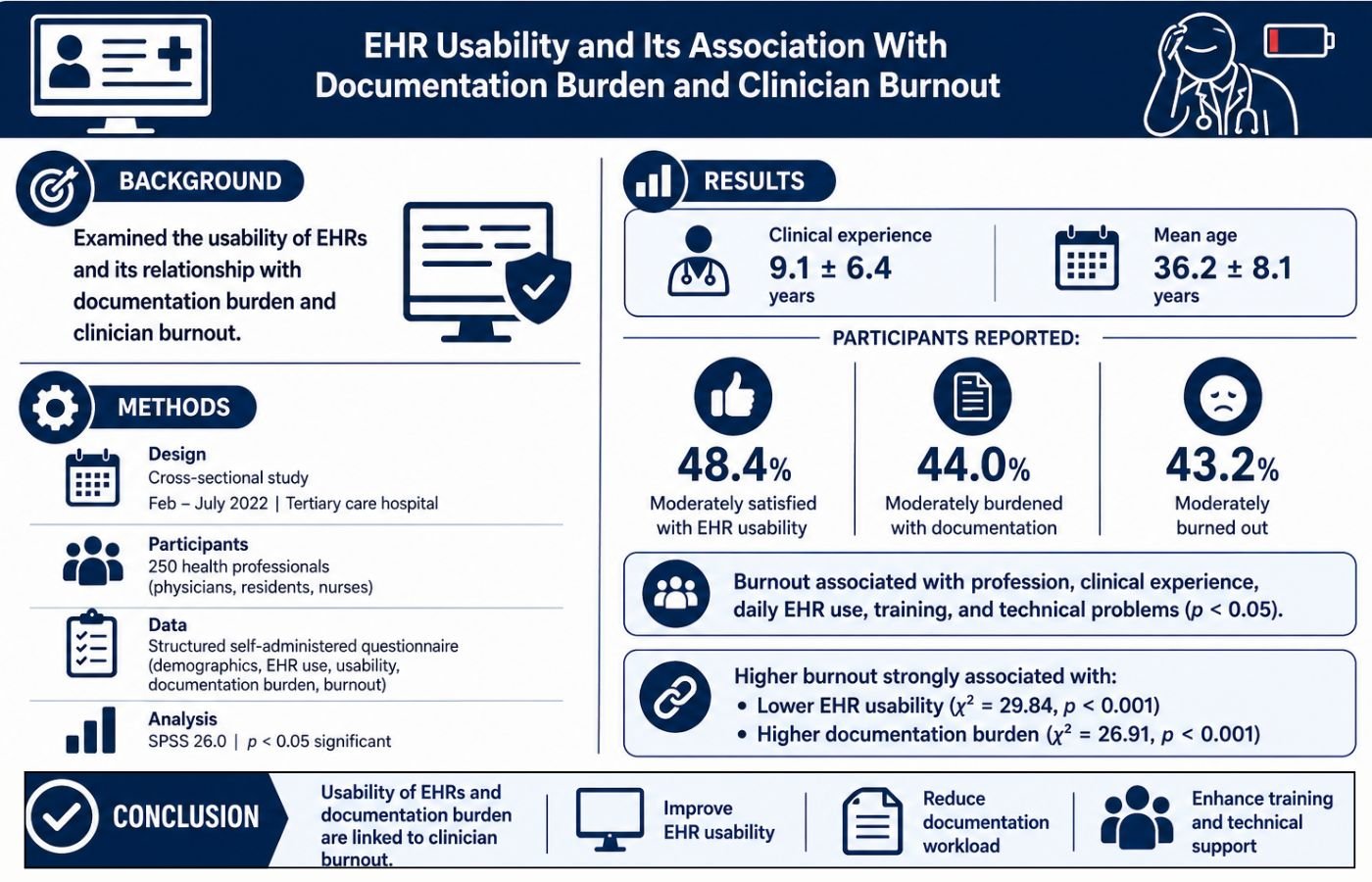
Background: Electronic Health Record (EHR) systems are a crucial part of the healthcare landscape in the modern era, fostering better access to patient information and facilitating clinical decision-making. The purpose of this study was to explore the usability of EHRs and its relationship with documentation burden and clinician burnout. Methods: The study was designed as a cross-sectional study and conducted between February and July 2022 at a tertiary care teaching hospital with a sample size of 250 health professionals (physicians, residents, and nurses). Participants filled out a structured, self-administered questionnaire covering the following domains: Demographic characteristics, EHR use, usability of EHRs, documentation burden, and clinician burnout (IBM SPSS Statistics 26.0, p value < 0.05 as significant). Results: Clinical experience among the participants was 9.1 ± 6.4 years and their mean age was 36.2 ± 8.1 years. 48.4% of participants reported being moderately satisfied with EHR usability, 44.0% moderately burdened with documentation, and 43.2% moderately burned out. Clinician burnout was significantly associated with profession, clinical experience, daily use of EHRs, formal training in EHRs, and technical problems, with a p value < 0.05. Increased clinician burnout was strongly associated with decreased EHR usability (χ² = 29.84, p < 0.001) and increased documentation burden (χ² = 26.91, p < 0.001). Conclusions: Usability of EHRs and burden of documentation were significantly linked to clinician burnout. Enhancing the usability of EHRs, reducing documentation workload, and improving user training and technical support could positively impact clinician well-being and healthcare outcomes.References
1. Tsai CH, Eghdam A, Davoody N, Wright G, Flowerday S, Koch S. Effects of Electronic Health Record Implementation and Barriers to Adoption and Use: A Scoping Review and Qualitative Analysis of the Content. Life (Basel). 2020 Dec 4;10(12):327. https://doi.org/10.3390/life10120327
2. Torab-Miandoab A, Samad-Soltani T, Jodati A, Akbarzadeh F, Rezaei-Hachesu P. The impact of electronic medical records on clinical documentation: A case study. J Educ Health Promot. 2025 Jul 4;14:246. https://doi.org/10.4103/jehp.jehp_320_24
3. Olakotan O, Samuriwo R, Ismaila H, Atiku S. Usability Challenges in Electronic Health Records: Impact on Documentation Burden and Clinical Workflow: A Scoping Review. J Eval Clin Pract. 2025 Jun;31(4):e70189. https://doi.org/10.1111/jep.70189
4. Cahill M, Cleary BJ, Cullinan S. The influence of electronic health record design on usability and medication safety: systematic review. BMC Health Serv Res. 2025 Jan 6;25(1):31. https://doi.org/10.1186/s12913-024-12060-2
5. Ha E, Choon-Kon-Yune I, Murray L, Luan S, Montague E, Bhattacharyya O, et al. Evaluating the Usability, Technical Performance, and Accuracy of Artificial Intelligence Scribes for Primary Care: Competitive Analysis. JMIR Hum Factors. 2025 Jul 23;12:e71434. https://doi.org/10.2196/71434
6. Atiku S, Olakotan O, Owolanke K. Usability-Related Barriers and Facilitators Influencing the Adoption and Use of AI Scribes in Healthcare: A Scoping Review. J Eval Clin Pract. 2026 Feb;32(1):e70365. https://doi.org/10.1111/jep.70365
7. Cho H, Nguyen OT, Weaver M, Pruitt J, Marcelle C, Salloum RG, et al. Electronic health record system use and documentation burden of acute and critical care nurse clinicians: a mixed-methods study. J Am Med Inform Assoc. 2024 Nov 1;31(11):2540-2549. https://doi.org/10.1093/jamia/ocae239
8. Oluwole OO, Haggerty N, Ikenyei U, Tinuoye O, Honora A, Issakah MA. Strategies and Tools for Electronic Health Records and Physician Workflow Alignment: Protocol for a Scoping Review. JMIR Res Protoc. 2025 Jun 2;14:e60464. https://doi.org/10.2196/60464
9. Murad MH, Vaa Stelling BE, West CP, Hasan B, Simha S, Saadi S, et al. Measuring Documentation Burden in Healthcare. J Gen Intern Med. 2024 Nov;39(14):2837-2848. https://doi.org/10.1007/s11606-024-08956-8
10. Heponiemi T, Gluschkoff K, Vehko T, Kaihlanen AM, Saranto K, Nissinen S, et al. Electronic Health Record Implementations and Insufficient Training Endanger Nurses' Well-being: Cross-sectional Survey Study. J Med Internet Res. 2021 Dec 23;23(12):e27096. https://doi.org/10.2196/27096
11. De Hert S. Burnout in Healthcare Workers: Prevalence, Impact and Preventative Strategies. Local Reg Anesth. 2020 Oct 28;13:171-183. https://doi.org/10.2147/LRA.S240564
12. Budd J. Burnout Related to Electronic Health Record Use in Primary Care. J Prim Care Community Health. 2023 Jan-Dec;14:21501319231166921. https://doi.org/10.1177/21501319231166921
13. Holmgren AJ, Hendrix N, Maisel N, Everson J, Bazemore A, Rotenstein L, et al. Electronic Health Record Usability, Satisfaction, and Burnout for Family Physicians. JAMA Netw Open. 2024 Aug 1;7(8):e2426956. https://doi.org/10.1001/jamanetworkopen.2024.26956
14. Alobayli F, O'Connor S, Holloway A, Cresswell K. Electronic Health Record Stress and Burnout Among Clinicians in Hospital Settings: A Systematic Review. Digit Health. 2023 Dec 19;9:20552076231220241. https://doi.org/10.1177/20552076231220241
15. Tajirian T, Stergiopoulos V, Strudwick G, Sequeira L, Sanches M, Kemp J, et al. The Influence of Electronic Health Record Use on Physician Burnout: Cross-Sectional Survey. J Med Internet Res. 2020 Jul 15;22(7):e19274. https://doi.org/10.2196/19274
16. Murphy DR, Satterly T, Giardina TD, Sittig DF, Singh H. Practicing Clinicians' Recommendations to Reduce Burden from the Electronic Health Record Inbox: a Mixed-Methods Study. J Gen Intern Med. 2019 Sep;34(9):1825-1832. https://doi.org/10.1007/s11606-019-05112-5
17. Asgari E, Kaur J, Nuredini G, Balloch J, Taylor AM, Sebire N, et al. Impact of Electronic Health Record Use on Cognitive Load and Burnout Among Clinicians: Narrative Review. JMIR Med Inform. 2024 Apr 12;12:e55499. https://doi.org/10.2196/55499
18. Poon EG, Trent Rosenbloom S, Zheng K. Health information technology and clinician burnout: Current understanding, emerging solutions, and future directions. J Am Med Inform Assoc. 2021 Apr 23;28(5):895-898. https://doi.org/10.1093/jamia/ocab058
19. Nguyen OT, Jenkins NJ, Khanna N, Shah S, Gartland AJ, Turner K, et al. A systematic review of contributing factors of and solutions to electronic health record-related impacts on physician well-being. J Am Med Inform Assoc. 2021 Apr 23;28(5):974-984. https://doi.org/10.1093/jamia/ocaa339
20. Sloss EA, Abdul S, Aboagyewah MA, Beebe A, Kendle K, Marshall K, et al. Toward Alleviating Clinician Documentation Burden: A Scoping Review of Burden Reduction Efforts. Appl Clin Inform. 2024 May;15(3):446-455. https://doi.org/10.1055/s-0044-1787007
Published
Issue
Section
License
Copyright (c) 2026 Muhammad Kamram, Muhammad Arsalan Shah (Author)

This work is licensed under a Creative Commons Attribution-NonCommercial 4.0 International License.
Journal of Medical and Multidisciplinary Healthcare Research (JMMHR) follows the Attribution Creative Commons-Non commercial (CC BY-NC 4.0) license which allows the users to copy and redistribute the material in any medium or format, remix, transform and build upon the material. The users must give credit to the source and indicate, provide a link to the license, and indicate if changes were made. However, the CC BY-NC 4.0 license restricts the use of material for commercial purposes (Further details are available at website. The Editorial Board of the JSAMR endeavors to ensure the accuracy, integrity, and quality of all published content. However, the responsibility of opinions, interpretations, and conclusions expressed in the published articles rests entirely with the authors and do not necessarily reflect the views of the Editorial Board, publisher, or affiliated institutions.