
Postoperative Pain Management Practices Among Surgical Patients
DOI:
https://doi.org/10.68041/jmmhr.v1i1/04Keywords:
postoperative pain, pain management, multimodal analgesia, rescue analgesia, Numeric Rating Scale, surgical patientsAbstract
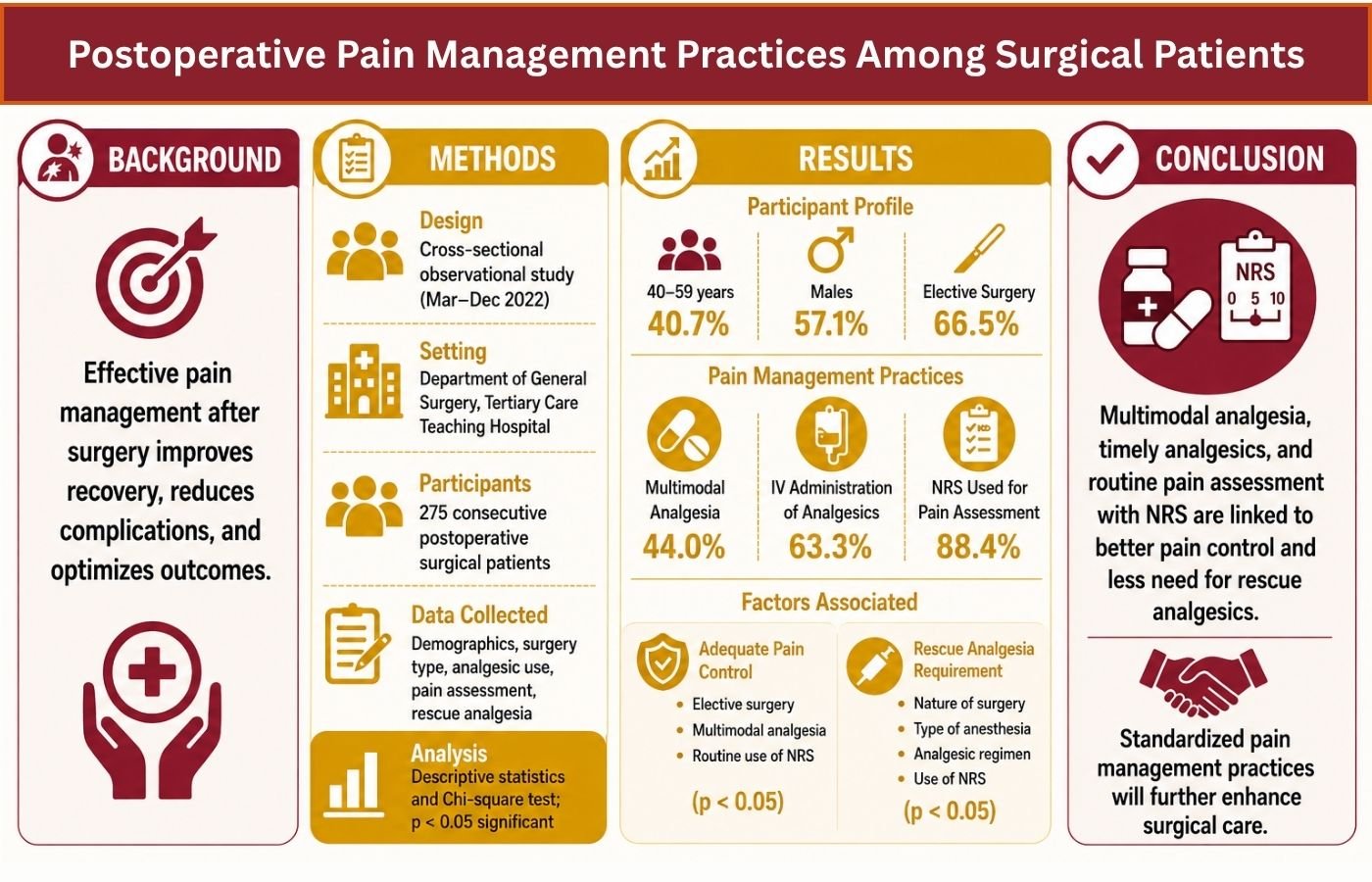
Background: Postoperative pain management is crucial for successful recovery, minimal complications, and optimal surgical outcomes. In this study, the postoperative management of pain was assessed in surgical patients and potential factors related to good postoperative pain control and rescue analgesia were identified. Methods: A Cross sectional observational study was conducted in the Department of General surgery of a tertiary care teaching hospital from March to December 2022. This study employed consecutive sampling, with a total of 275 patients with surgical postsurgery included. A structured data collection proforma was used to collect data related to demographic characteristics, surgical type, use of analgesics, pain assessment, and requirement for rescue analgesics. Descriptive statistics and Chi-square test were used for data analysis and p <0.05 was considered statistically significant. Results: Most participants were 40–59 years (40.7%), 57.1% were males, and 66.5% underwent elective surgery. The most common methods of pain management were multimodal analgesia (44.0 %), intravenous administration of analgesics (63.3 %), and the Numeric Rating Scale (88.4 %). Elective surgery, the use of multimodal analgesia, and the use of routine NRS were all significantly associated with adequate pain control (p<0.05). There was a significant association with the nature of surgery, type of anesthesia, analgesic regimen and the use of NRS (p<0.05) for rescue analgesia requirement. Conclusions: Multimodal analgesia, timely administration of analgesics and routine evaluation of pain with the Numeric Rating Scale was correlated with better postoperative pain management and less need for rescue analgesics.
References
1. Gao L, Mu H, Lin Y, Wen Q, Gao P. Review of the Current Situation of Postoperative Pain and Causes of Inadequate Pain Management in Africa. J Pain Res. 2023 May 29;16:1767-1778.
https://doi.org:/10.2147/JPR.S405574
2. Park R, Mohiuddin M, Arellano R, Pogatzki-Zahn E, Klar G, Gilron I. Prevalence of Postoperative Pain Following Hospital Discharge: Protocol for a Systematic Review. JMIR Res Protoc. 2020 Dec 4;9(12):e22437. https://doi.org:/10.2196/22437
3. Javed H, Olanrewaju OA, Ansah Owusu F, Saleem A, Pavani P, Tariq H, et al. Challenges and Solutions in Postoperative Complications: A Narrative Review in General Surgery. Cureus. 2023 Dec 22;15(12):e50942. https://doi.org:/10.7759/cureus.50942
4. Fose N, Singh AR, Krishnamurthy S, Ratshitanga M, Moodley P. Empowering distribution system operators: A review of distributed energy resource forecasting techniques. Heliyon. 2024 Jul 22;10(15):e34800. https://doi.org:/10.1016/j.heliyon.2024.e34800
5. Komasawa N. Revitalizing Postoperative Pain Management in Enhanced Recovery After Surgery via Inter-departmental Collaboration Toward Precision Medicine: A Narrative Review. Cureus. 2024 Apr 25;16(4):e59031. https://doi.org:/10.7759/cureus.59031
6. Majerić Kogler V, Lončarić Katušin M, Kogler J. EVIDENCE-BASED STRATEGIES FOR MULTIMODAL POSTOPERATIVE PAIN MANAGEMENT. Acta Clin Croat. 2023 Nov;62(Suppl4):107-114. https://doi.org:/10.20471/acc.2023.62.s4.16
7. Sezerano ML, Niyonkuru E. Personalized Multimodal and Opioid-Sparing Analgesia for Postoperative Pain Management: Enhancing Recovery and Addressing the Post-Discharge Gap. J Pain Res. 2026 Apr 16;19:597049. https://doi.org:/10.2147/JPR.S597049
8. Wazir S, Inayat S, Ullah MJ, Zaman G, Rehman A, Faisal, et al. Multimodal analgesia in resource-limited settings: A comparative analysis of postoperative pain management strategies in Pakistan. PLOS Glob Public Health. 2025 Dec 19;5(12):e0005345. https://doi.org:/10.1371/journal.pgph.0005345
9. Lidauer SM, Hoppu S, Kaartinen K, Lidauer MH, Kalliomäki ML. Pain Assessment and Its Effect on Pain Management During Emergency Medical Services-A Descriptive Study in the Tampere University Hospital Area of Finland. Acta Anaesthesiol Scand. 2025 Jul;69(6):e70047. https://doi.org:/10.1111/aas.70047
10. Schwenk ES, Mariano ER. Designing the ideal perioperative pain management plan starts with multimodal analgesia. Korean J Anesthesiol. 2018 Oct;71(5):345-352. https://doi.org:/10.4097/kja.d.18.00217
11. Laksono RM, Musba AMT, Siswagama TA, Fitrisyah A, Rofiq A, Adithya B, et al. Variability of post-operative acute pain management and the association of patients' socio-demographics on pain management outcome in Indonesia: A multicenter hospital-based observational study. Dialogues Health. 2026 Mar 18;8:100300. https://doi.org:/10.1016/j.dialog.2026.100300
12. Gautam A, Pande C, Pande M. Postoperative Pain Management: Evaluating the Role of Multimodal Analgesia. J Pharm Bioallied Sci. 2025 May;17(Suppl 1):S314-S316. https://doi.org:/10.4103/jpbs.jpbs_1949_24
13. Yun JK, Lee HP, Lee GD, Kim HR, Kim YH, Kim DK, et al. Recent Trends in Demographics, Surgery, and Prognosis of Patients with Surgically Resected Lung Cancer in a Single Institution from Korea. J Korean Med Sci. 2019 Nov 25;34(45):e291. https://doi.org:/10.3346/jkms.2019.34.e291
14. Negruț RL, Coțe A, Maghiar AM. A Retrospective Analysis of Emergency Versus Elective Surgical Outcomes in Colon Cancer Patients: A Single-Center Study. J Clin Med. 2024 Oct 30;13(21):6533. https://doi.org:/10.3390/jcm13216533
15. Cui X, Zhang J, Gao Z, Cai J, Wang F, Li L, et al. Early Postoperative Analgesic Outcomes Following Pre-Induction Intravenous Ibuprofen in Children Undergoing Hypospadias Repair: A Randomized Controlled Study. Children (Basel). 2026 Feb 27;13(3):342. https://doi.org:/10.3390/children13030342
16. YaDeau JT, Soffin EM, Tseng A, Zhong H, Dines DM, Dines JS, et al. A Comprehensive Enhanced Recovery Pathway for Rotator Cuff Surgery Reduces Pain, Opioid Use, and Side Effects. Clin Orthop Relat Res. 2021 Aug 1;479(8):1740-1751. https://doi.org:/10.1097/CORR.0000000000001684
17. Govas P, Ketchum A, Kazi R, Gordon BR, Carroll BT. Pain Intensity Assessment Scales for Dermatologic Surgery Patients: A Systematic Review. Dermatol Surg. 2022 Feb 1;48(2):232-238. https://doi.org:/10.1097/DSS.0000000000003353
18. Sierżantowicz R, Lewko J, Bitiucka D, Lewko K, Misiak B, Ładny JR. Evaluation of Pain Management after Surgery: An Observational Study. Medicina (Kaunas). 2020 Feb 7;56(2):65. https://doi.org:/10.3390/medicina56020065
19. Rababa M, Al-Sabbah S, Hayajneh AA. Nurses' Perceived Barriers to and Facilitators of Pain Assessment and Management in Critical Care Patients: A Systematic Review. J Pain Res. 2021 Nov 5;14:3475-3491. https://doi.org:/10.2147/JPR.S332423
20. Ghai B, Jafra A, Bhatia N, Chanana N, Bansal D, Mehta V. Opioid sparing strategies for perioperative pain management other than regional anaesthesia: A narrative review. J Anaesthesiol Clin Pharmacol. 2022 Jan-Mar;38(1):3-10. https://doi.org:/10.4103/joacp.JOACP_362_19
21. Prabhakar NK, Chadwick AL, Nwaneshiudu C, Aggarwal A, Salmasi V, Lii TR, et al. Management of Postoperative Pain in Patients Following Spine Surgery: A Narrative Review. Int J Gen Med. 2022 May 2;15:4535-4549. https://doi.org:/10.2147/IJGM.S292698
22. Jipa M, Isac S, Klimko A, Simion-Cotorogea M, Martac C, Cobilinschi C, et al. Opioid-Sparing Analgesia Impacts the Perioperative Anesthetic Management in Major Abdominal Surgery. Medicina (Kaunas). 2022 Mar 28;58(4):487. https://doi.org:/10.3390/medicina58040487
23. Barney CC, Andersen RD, Defrin R, Genik LM, McGuire BE, Symons FJ. Challenges in pain assessment and management among individuals with intellectual and developmental disabilities. Pain Rep. 2020 Jun 16;5(4):e821. https://doi.org:/10.1097/PR9.0000000000000822
24. Lotan M, Icht M. Diagnosing Pain in Individuals with Intellectual and Developmental Disabilities: Current State and Novel Technological Solutions. Diagnostics (Basel). 2023 Jan 22;13(3):401. https://doi.org:/10.3390/diagnostics13030401
Published
Issue
Section
License
Copyright (c) 2026 Zainab Mubashir, Faiza Kamran (Author)

This work is licensed under a Creative Commons Attribution-NonCommercial 4.0 International License.
Journal of Medical and Multidisciplinary Healthcare Research (JMMHR) follows the Attribution Creative Commons-Non commercial (CC BY-NC 4.0) license which allows the users to copy and redistribute the material in any medium or format, remix, transform and build upon the material. The users must give credit to the source and indicate, provide a link to the license, and indicate if changes were made. However, the CC BY-NC 4.0 license restricts the use of material for commercial purposes (Further details are available at website. The Editorial Board of the JSAMR endeavors to ensure the accuracy, integrity, and quality of all published content. However, the responsibility of opinions, interpretations, and conclusions expressed in the published articles rests entirely with the authors and do not necessarily reflect the views of the Editorial Board, publisher, or affiliated institutions.