
Evaluating Digital Health Literacy Among Patients Attending Outpatient Clinics
DOI:
https://doi.org/10.68041/jmmhr.v1i1/05Keywords:
Digital health literacy, Outpatient clinics, Internet use, Cross-sectional study, Health information seeking, eHealth literacyAbstract
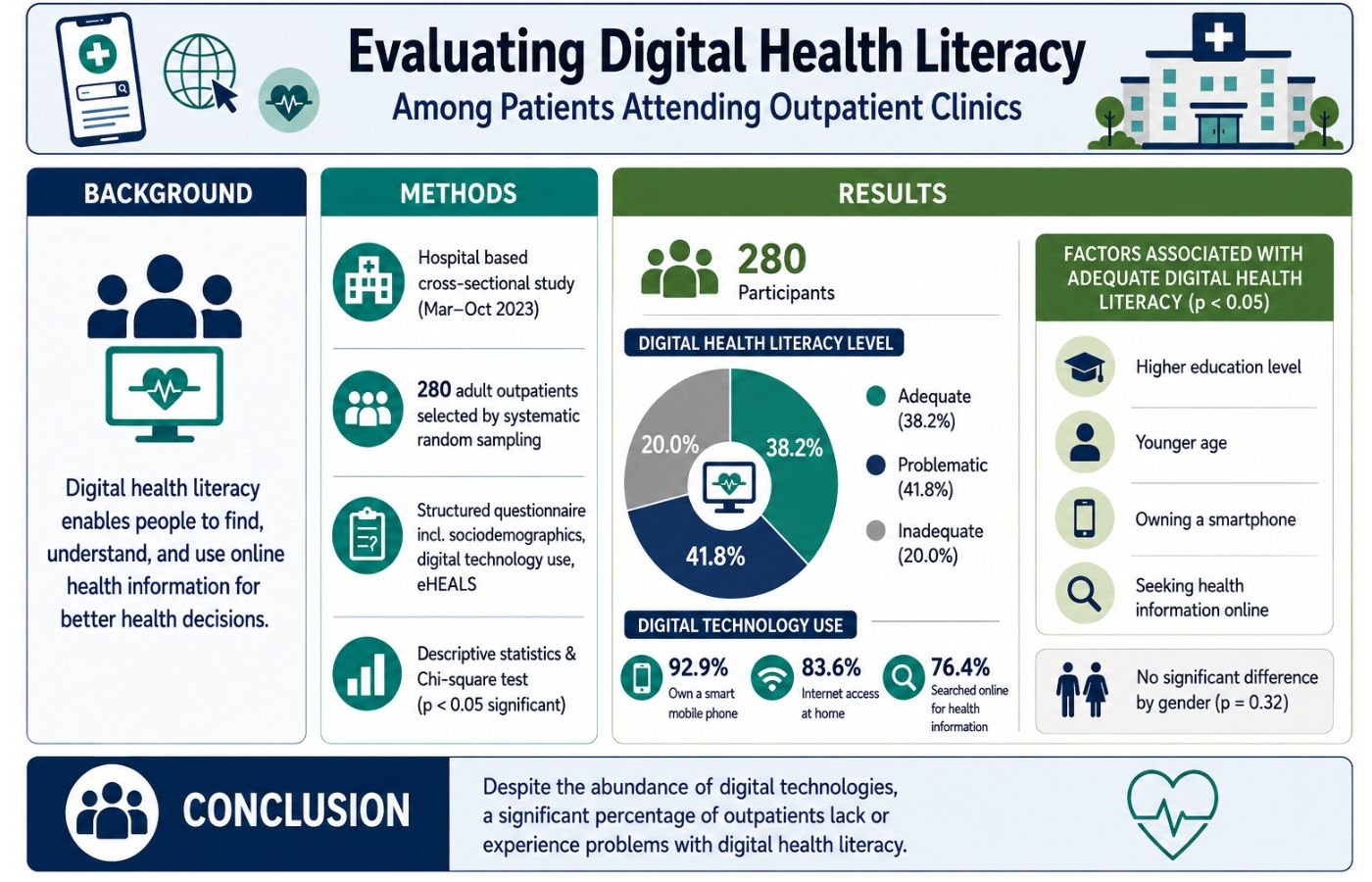
Background: Digital health literacy is crucial for facilitating people to access, comprehend, critique, and use internet health information to make decisions. Digital health literacy is a potential barrier to using digital health resources and may negatively impact health outcomes. This study evaluated the level of digital health literacy in the outpatient clinics and explored the factors associated with digital health literacy. Methods: This was a hospital based cross-sectional study of 280 adult patients visiting the outpatient department of a tertiary care teaching hospital from March to October 2023. Participants were selected in a systematic random sampling. A structured questionnaire was used for data collection and contained sociodemographic data, usage of digital technology, and the eHealth Literacy Scale (eHEALS). The data was presented in descriptive statistics and associations between the participant characteristics and the digital health literacy were evaluated by the Chi-square test. The p-value of <0.05 was deemed to be statistically significant. Results: Of the 280 participants, 38.2% had adequate digital health literacy, while 41.8% had problematic and 20.0% had inadequate digital health literacy. Most of the participants had a smart mobile phone (92.9%), internet access at home (83.6%) and searched online for health information (76.4%). Significant associations with sufficient digital health literacy (p <0.05) included higher education level, younger age, and owning a smartphone as well as users seeking health information online. Conclusion: Despite the abundance of digital technologies, a significant percentage of patients who attended the outpatient clinics lacked digital health literacy, or experienced problems with it.
References
1. Stoumpos AI, Kitsios F, Talias MA. Digital Transformation in Healthcare: Technology Acceptance and Its Applications. Int J Environ Res Public Health. 2023 Feb 15;20(4):3407.
https://doi.org/10.3390/ijerph20043407
2. Rosenlund M, Kinnunen UM, Saranto K. The Use of Digital Health Services Among Patients and Citizens Living at Home: Scoping Review. J Med Internet Res. 2023 Mar 27;25:e44711. https://doi.org/10.2196/44711
3. Fitzpatrick PJ. Improving health literacy using the power of digital communications to achieve better health outcomes for patients and practitioners. Front Digit Health. 2023 Nov 17;5:1264780. https://doi.org/10.3389/fdgth.2023.1264780
4. Johnson HM. The impact of health misinformation and health literacy on the management of dyslipidemia. Am J Prev Cardiol. 2025 Sep 9;24:101289. https://doi.org/10.1016/j.ajpc.2025.101289
5. Ban S, Kim Y, Seomun G. Digital health literacy: A concept analysis. Digit Health. 2024 Oct 7;10:20552076241287894. https://doi.org/10.1177/20552076241287894
6. Yuen E, Winter N, Savira F, Huggins CE, Nguyen L, Cooper P, et al. Digital Health Literacy and Its Association With Sociodemographic Characteristics, Health Resource Use, and Health Outcomes: Rapid Review. Interact J Med Res. 2024 Jul 26;13:e46888. https://doi.org/10.2196/46888
7. Tan G, Chao J, Jin S, Wang L, Wu Y, Du Y, et al. The association between digital health literacy and health inequalities among Chinese older adults: A multicenter cross-sectional study. Digit Health. 2025 Jun 20;11:20552076251349901. https://doi.org/10.1177/20552076251349901
8. Qasrawi R, Al Sabbah H, Issa G, Thwib S, Amro M, Atari S, et al. Assessing the impact of digital health literacy on health management practices in Arab Middle Eastern and North African countries: insights from predictive modeling. Front Digit Health. 2025 Oct 3;7:1555436. https://doi.org/10.3389/fdgth.2025.1555436
9. Doris O, Morrissey EC. Experiences of students with chronic illness in university education in Ireland. Chronic Illn. 2025 Jun;21(2):277-290. https://doi.org/10.1177/17423953241282246
10. Yoon J, Yang S, Kang SJ, Lee M, Kim D, Park J, et al. Digital Health Literacy in the General Population: National Cross-Sectional Survey Study. J Med Internet Res. 2025 Sep 22;27:e67780. https://doi.org/10.2196/67780
11. Daba W, Mekonnen M, Biru W, Zewdu T, Demeke A. Patient engagement in their healthcare decision making and associated factors among adult outpatients with non-communicable chronic diseases in public hospitals of North Shewa Zone, central Ethiopia: a mixed-method study. BMC Public Health. 2025 Oct 28;25(1):3627. https://doi.org/10.1186/s12889-025-24853-z
12. Dibera KD, Debancho WW, Bedada GB, Dugasa YG. Patients' perceived involvement in clinical decision-making and associated factors among adult patients admitted at Jimma Medical Center, Oromia, Ethiopia: a cross-sectional study. BMJ Open. 2024 Dec 22;14(12):e085984. https://doi.org/10.1136/bmjopen-2024-085984
13. Lim WX, Lim HM, Lee YK, Chuah CJW, Abdullah A, Ng CJ, et al. Appropriate trust in online health information is associated with information platform, commercial status, and misinformation in patients with high cardiovascular risk. Digit Health. 2025 Apr 29;11:20552076251334438. https://doi.org/10.1177/20552076251334438
14. Arias López MDP, Ong BA, Borrat Frigola X, Fernández AL, Hicklent RS, Obeles AJT, et al. Digital literacy as a new determinant of health: A scoping review. PLOS Digit Health. 2023 Oct 12;2(10):e0000279. https://doi.org/10.1371/journal.pdig.0000279
15. Yang J, Shen Q, Tong X, Mukhopadhaya P. The impact of digital literacy in enhancing individuals' health in China. BMC Public Health. 2025 Jan 29;25(1):364. https://doi.org/10.1186/s12889-025-21454-8
16. Muellmann S, Wiersing R, Zeeb H, Brand T. Digital Health Literacy in Adults With Low Reading and Writing Skills Living in Germany: Mixed Methods Study. JMIR Hum Factors. 2025 May 22;12:e65345. https://doi.org/10.2196/65345
17. Zhao BY, Huang L, Cheng X, Chen TT, Li SJ, Wang XJ, et al. Digital health literacy and associated factors among internet users from China: a cross-sectional study. BMC Public Health. 2024 Mar 27;24(1):908. https://doi.org/10.1186/s12889-024-18324-0
18. Liu S, Zhao H, Fu J, Kong D, Zhong Z, Hong Y, et al. Current status and influencing factors of digital health literacy among community-dwelling older adults in Southwest China: a cross-sectional study. BMC Public Health. 2022 May 17;22(1):996. https://doi.org/10.1186/s12889-022-13378-4
19. Yoon J, Yang S, Kang SJ, Lee M, Kim D, Park J, et al. Digital Health Literacy in the General Population: National Cross-Sectional Survey Study. J Med Internet Res. 2025 Sep 22;27:e67780. https://doi.org/10.2196/67780
20. Abrha S, Abamecha F, Amdisa D, Tewolde D, Regasa Z. Electronic health literacy and its associated factors among university students using social network sites (SNSs) in a resource-limited setting, 2022: cross-sectional study. BMC Public Health. 2024 Dec 18;24(1):3444. https://doi.org/10.1186/s12889-024-21022-6
21. Monasterio G, Fernández-López MJ, Valero E, Martin U, Ayala-García A. Digital Inequalities in the Use of eHealth Services in European Public Health Care Systems: Systematic Review of Observational Studies. J Med Internet Res. 2026 Feb 9;28:e81841. https://doi.org/10.2196/81841
22. Cheng C, Gearon E, Hawkins M, McPhee C, Hanna L, Batterham R, et al. Digital Health Literacy as a Predictor of Awareness, Engagement, and Use of a National Web-Based Personal Health Record: Population-Based Survey Study. J Med Internet Res. 2022 Sep 16;24(9):e35772. https://doi.org/10.2196/35772
23. Cheng C, Elsworth G, Osborne RH. Validity Evidence Based on Relations to Other Variables of the eHealth Literacy Questionnaire (eHLQ): Bayesian Approach to Test for Known-Groups Validity. J Med Internet Res. 2021 Oct 14;23(10):e30243. https://doi.org/10.2196/30243
24. Chen LL, Guo Z, Liang Q. Gender differences in digital literacy: a systematic and meta-analytic review across developmental stages and socio-cultural contexts. Front Psychol. 2026 Feb 16;17:1673694. https://doi.org/10.3389/fpsyg.2026.1673694
25. Perera C, Bakrania S, Ipince A, Nesbitt-Ahmed Z, Obasola O, Richardson D, et al. Impact of social protection on gender equality in low- and middle-income countries: A systematic review of reviews. Campbell Syst Rev. 2022 May 25;18(2):e1240. https://doi.org/10.1002/cl2.1240
Published
Issue
Section
License
Copyright (c) 2026 Maryum Qayyum, Kainat Akhtar (Author)

This work is licensed under a Creative Commons Attribution-NonCommercial 4.0 International License.
Journal of Medical and Multidisciplinary Healthcare Research (JMMHR) follows the Attribution Creative Commons-Non commercial (CC BY-NC 4.0) license which allows the users to copy and redistribute the material in any medium or format, remix, transform and build upon the material. The users must give credit to the source and indicate, provide a link to the license, and indicate if changes were made. However, the CC BY-NC 4.0 license restricts the use of material for commercial purposes (Further details are available at website. The Editorial Board of the JSAMR endeavors to ensure the accuracy, integrity, and quality of all published content. However, the responsibility of opinions, interpretations, and conclusions expressed in the published articles rests entirely with the authors and do not necessarily reflect the views of the Editorial Board, publisher, or affiliated institutions.